
A well-diversified portfolio generally consists of fixed income assets and common shares (also called stocks or equities).
A common share is a negotiable title (on a stock exchange), representing part of the share capital of a capital company. Simply put, owning a stock is becoming the owner (or shareholder) of a portion of a business. This means having the right to vote and the possibility of receiving dividends. A dividend is a distribution of part of the profits to its shareholders.
The return on common stocks is made up of capital gain (or loss) and dividends. The vast majority of companies pay dividends, but some do not. This is especially the case with high growth companies that require a lot of capital. Unlike fixed income assets, stocks do not have a maturity date. There are different classes of common shares. The only difference is the number of votes per share.
What are the main characteristics of the stock market?
In the previous chronicle, we saw that the main characteristics of bonds are maturity and credit quality. For its part, the stock market is much more heterogeneous and the dispersion of returns is much higher.
In this market, diversification and investment opportunities are found on several axes:
- By geographic area: regions and countries. For example, Europe, United States, etc.
- By sectors and industries: for example, oil and gas, consumer, pharmaceutical etc.
- By size: small, medium and large caps
- By currency: Euro, USD, Yen
- By style: growing business, mature business, etc.
- Specific titles: Tesla, Apple, Amazon, Air Canada, etc.
What is the role of stocks in a portfolio?
- High returns: over the long term, the return on stocks is usually higher than that on bonds. We accept a certain volatility, but we can take advantage of global economic growth.
- Consistent Income: a diversified stock portfolio generates relatively stable dividends, often with favorable tax treatment (compared to bonds).
- Diversification: stocks do not move in sync with fixed income assets. Additionally, sector, country, style and size returns also help diversify the portfolio.
- Inflation protection: Corporate profits change with economic growth. Unlike fixed income assets, stocks are variable income securities whose prices adjust (in part or in whole) with inflation.
The relationship between interest rates and stock prices
In the previous chronicle, we demonstrated, with the discount formula, that the price of bonds is inversely related to movements in interest rates. Now we are going to look at the case of stocks. The link with interest rates is less direct.
How do you calculate the price of a stock?
To do this, we must resort, once again, to the concept of discounting that we saw in the chronicle on the basics of investing.
In fact, we use the same formula to value a bond and a stock. The difference is that instead of using fixed parameters (coupon, maturity), we have to work with variable parameters that we have to estimate.
The goal is always to actualize the cash flows that will be paid in future periods.
Here is a simple dividend discount model

Where Price = P0, divn = Dividend for period n, r = Interest rate, tn = time remaining until receipt of cash flow.
In the numerator, it will be necessary to assess, depending on the type of company and industry, what dividends will be paid and their growth over time.
In the denominator, we will have to determine our discount rate, in order to reflect the risk premiums associated with this investment (small cap stocks for example) and the risk-free rate. Risk premia change over time in line with investors’ risk aversion and tolerance.
Finally, what is the relationship between interest rates and stock prices? Consider an example where the expected inflation rate is increasing.
- The risk-free rate (discount rate) is expected to rise and lower the stock price.
- Profit and dividend expectations should be revised upwards, this would increase the price of the stock.
The effect of rising inflation has an impact in both the numerator and the denominator. For this reason, the impact of interest rates is more mixed on stocks.
What are the factors that influence actions?
Macro factors
- Global Economic Growth: A growing economy increases corporate profits.
- Interest rates: they affect the discount rate
- Risk aversion: The stock market moves in a cycle. Euphoria gives way to fear. This creates short-term volatility.
Micro Factors
- The business sector: risk premiums are higher in cyclical companies (Mining) than those in more stable sectors (Banks).
- The quality of the company’s balance sheet: for example, risk premiums are greater in highly indebted companies.
- Growth: Investors pay a higher multiple for growing companies.
- The size of the company: The risk premiums of small companies are higher than those of large ones.
The risk – return relationship of stocks
Let’s come back to the concept of risk and return. The riskier (and more volatile) an investment is, the higher the required return will be. An investor will be willing to tolerate some volatility in exchange for a higher expectation of payoff.
The return on an asset can be thought of as a combination of risk premiums. The following graph is a summary representation of the risk premiums for various investments.
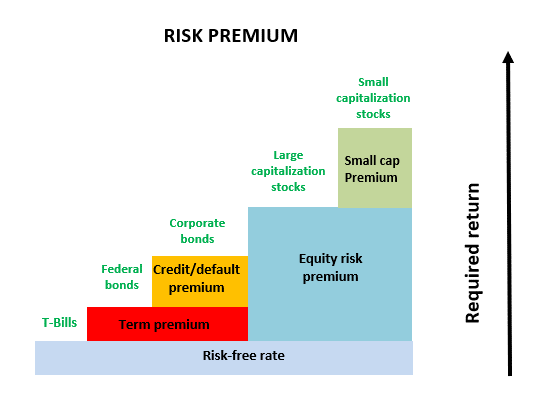
We could also have added a liquidity premium and a premium for emerging markets.
In the next chronicle, we will look at active vs. passive management as well as management fees.
Frédéric Mercier CFA, SIPC
Director – Financial markets