
FINANCIAL MARKETS REVIEW
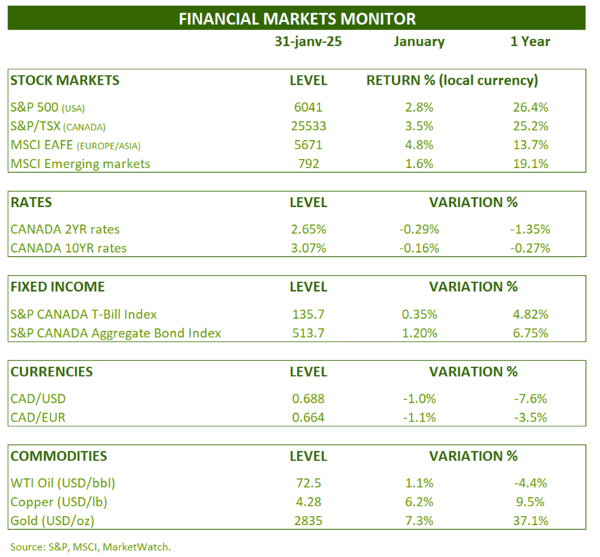
January was marked by bouts of volatility, courtesy of President Trump. Despite this, stock markets ended higher, following strong corporate financial results and falling inflation. The US stock market rose 2.8%, while the Canadian stock market climbed 3.5%.
Elsewhere in the world, stock markets were strongly positive, with a return of 4.8% in Europe-Asia.

The Bank of Canada lowered its key rate once again in January (-0.25%). The key rate is now 3%. In the United States, the federal funds rate remained unchanged at 4.33%.
Canadian 10-year yields fell by 0.16%, generating a strong performance of 1.20% for the Canadian bond index.

OUTLOOK:
Economy:
Two events that have occurred in the last week are likely to have significant impacts on the economic and financial sphere:
• The implementation of 25% customs tariffs by the Trump administration.
• The launch of the DeepSeek chatbot.
The implementation of 25% customs tariffs by the Trump administration:
Economists agree that the trade war with Canada is irrational and not based on facts. And no, the United States are not subsidizing Canada. Supply chains have been highly integrated since the creation of free trade. Everyone loses.
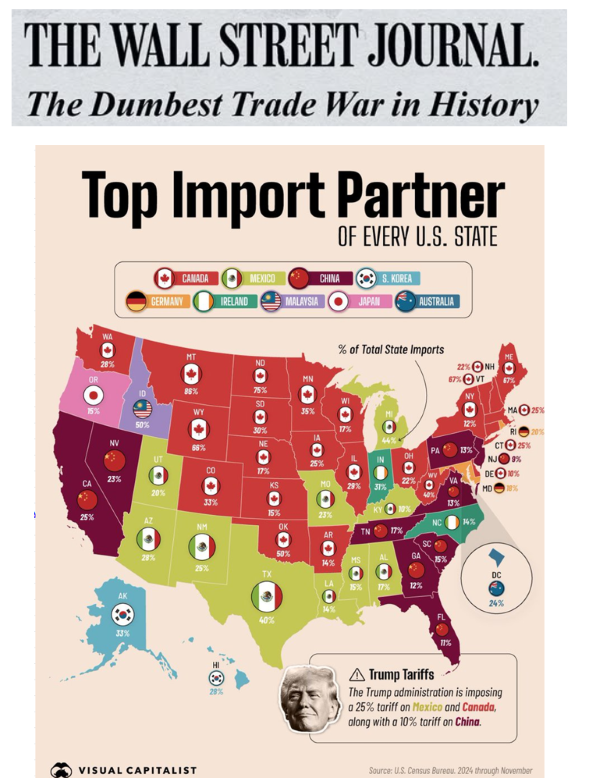
Trump’s maneuvers only increase uncertainty and volatility in the markets. It is very difficult for companies to invest with so much uncertainty.

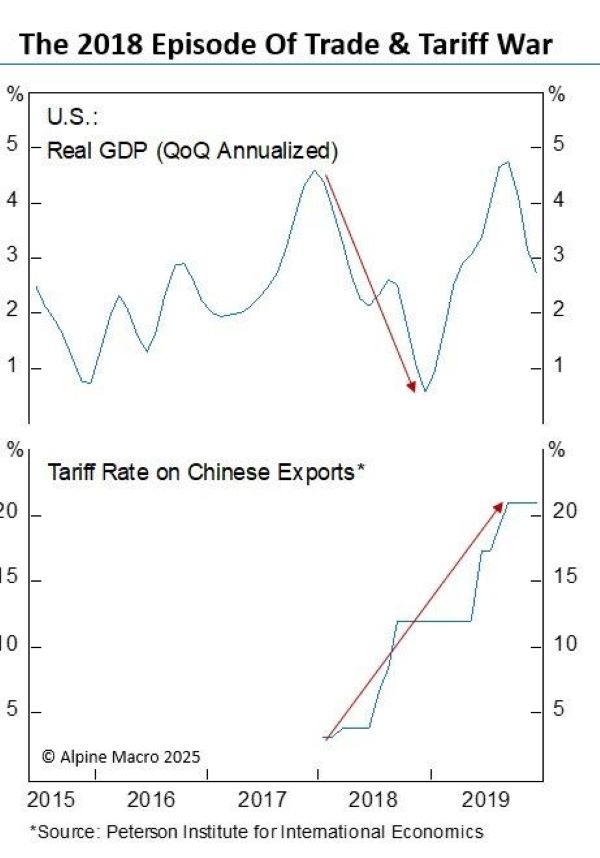
During the 2018-2019 US-China tariff war, increased uncertainty led to several corrections in the US stock market.

Also in 2018-2019, the increase in tariffs caused a tariff shock to American consumers, like a tax increase. This was negative for GDP. When the tariffs were announced in 2025, the reaction was in this direction. Stocks corrected, but bonds gained value (which would not have happened if inflationary fears had been anticipated)
In short, it is difficult to predict what will happen, but betting sites already see that this war will be very short. Even before it begins, the rates are already pushed back by a month!

The launch of DeepSeek’s chatbot:
Although several elements raise questions (notably the minimal development costs), experts agree that this is a major technological breakthrough. Indeed, DeepSeek achieves similar performances to what is already on the market, but with radically improved efficiency. At a given number of calculations, DeepSeek would be 94% less expensive (notably in terms of energy) than ChatGPT. Finally, the software code is public, allowing other players to improve their efficiency and performance.
In the medium term, this is very good news for the economy in general. As artificial intelligence becomes more widespread, productivity gains will be spread across all companies and organizations. However, some companies (like Nvidia) could lose competitive advantages and partially deflate on the stock market.
Before Trump started talking about tariffs, the American economy was doing rather well. Manufacturing new orders indices continue to rise, the fight against inflation is progressing well, which allows the Fed to gradually lower its rates.
On the employment front, encouraging signs are on the horizon. For example, hiring intentions from American small businesses (NFIB) suggest that unemployment could start to fall again soon.
NFIB Hiring Index and Unemployment Rate (United States):
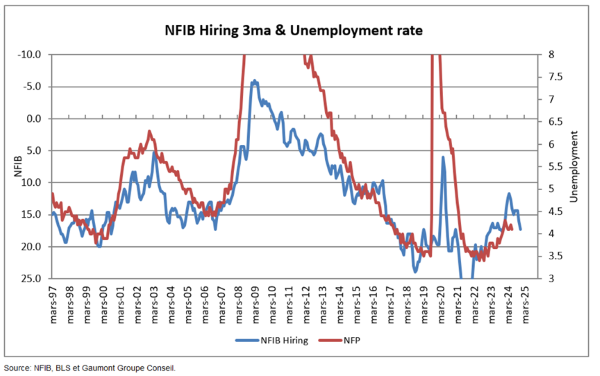
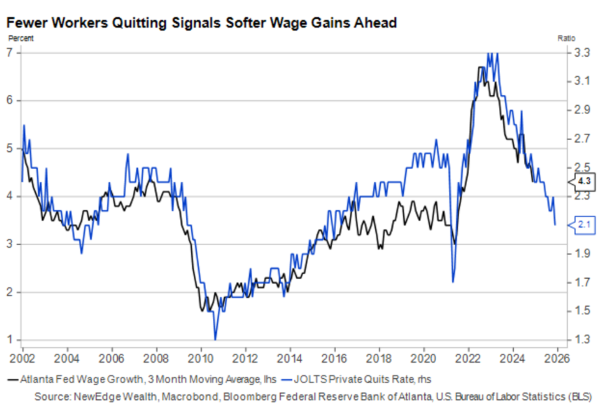
Although the job market appears to be improving, the number of voluntary departures continues to decline. This reduces bargaining leverage and wage pressures. This will facilitate the decline in inflation.
Voluntary employee departures and wage growth (United States):
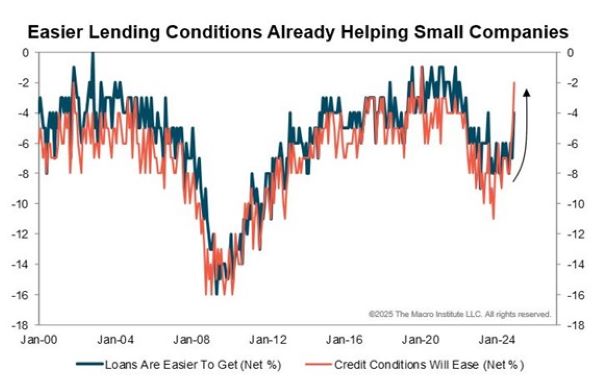
Credit conditions have returned to near normal, supporting long-term business investment.
Credit conditions and total loan demand (U.S.):
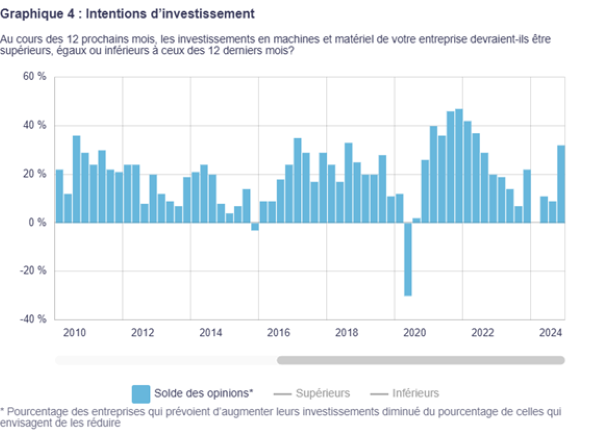
Like the United States, Canada also appears to be on the right track in terms of economic growth. Anticipated sales growth is at a 4-year high, wage pressures are under control and hiring intentions are also improving. Finally, as shown in the following chart, investment intentions are now above the average of the last 15 years.
Bank of Canada Business Outlook Survey – Investment Intentions:
Fixed Income:
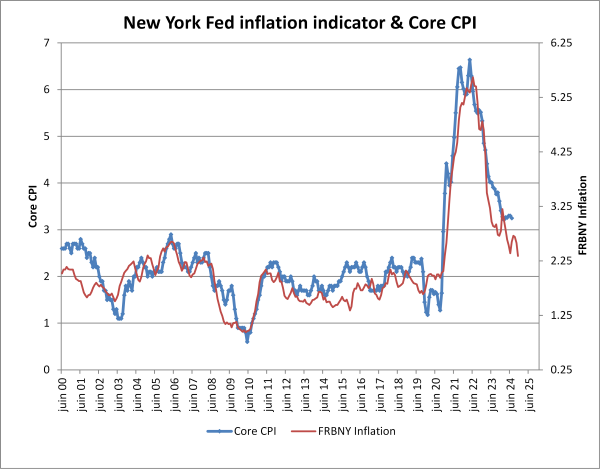
The New York Federal Reserve’s leading inflation indicator continues to trend in the right direction. Core inflation is expected to head toward 2.3% by this summer.
FED Inflation Indicator and Core Inflation (U.S.):
The housing component is one that is pushing down overall inflation. The New Lease Rental Price Index is now in negative territory. In Q4 2024, prices fell by 2.43% (compared to Q4 2023), the largest decline since 2009. These declines are expected to be reflected in official inflation figures within 2-3 quarters.
New Lease Rental and Housing CPI (US):

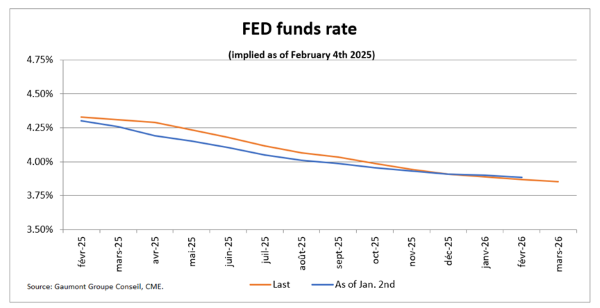
In order not to increase real rates, monetary policy will continue to be eased this year. Market participants anticipate total cuts of 0.50% in the United States in 2025.
Implied short-term interest rates (United States):
Stock Markets:
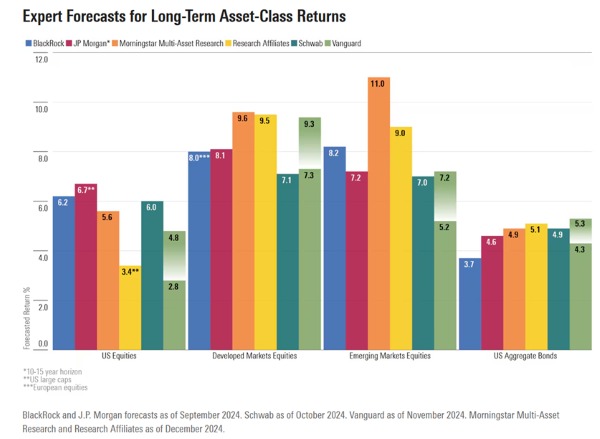
As we know, stock markets bring their share of volatility. This volatility can be the tree that hides the forest. From time to time, it is beneficial to look beyond daily performances. Major banks and fund managers publish their long-term return assessments each year. This exercise gives an idea of the returns by asset class, but especially their ranking.
Unsurprisingly, US stocks offer a low additional return compared to bonds. In addition, the returns offered by developed markets (which include the USA) and emerging countries come before those of the US market.
Return expectations of various asset classes:
Some will say that the US market is more expensive than others, due to its high weighting in technology stocks. They are partly right. In order to exclude this factor, we can analyze the valuations by sector. In the following graph, we see that all sectors are trading at a higher relative valuation than historical.
Valuations by sector: World vs. United States (US):

The election of Donald Trump has created a lot of volatility. The president can reverse the market trend with a single tweet. This is what happened in the first half of January, with the start of the tariff speech. The market panics and the bargains come. With the positive backdrop we have at the moment (inflation, falling rates and growing corporate profits), buying quality stocks during panic moments is a good strategy.
Sentiment on the US stock market:

CONCLUSION :
With the exception of some US technology stocks, equity markets are fairly valued. Bond risk premiums also remain attractive. The strategy remains to use market volatility (buy in panic and sell in euphoria) to acquire quality stocks at a reasonable fundamental valuation.
Frédéric Mercier CFA, SIPC
Director – Financial markets