

FINANCIAL MARKETS REVIEW
The trends observed in February continued in March. Technology stocks (Mag7) lost more than 10%, while the S&P 500 index lost 5.6%. Defensive stocks and sectors performed best.
The Canadian market, although negative, strongly outperformed the US stock market. The Euro-Asian markets generated a performance of -2.8%. Emerging markets ended the month with a slightly positive performance.

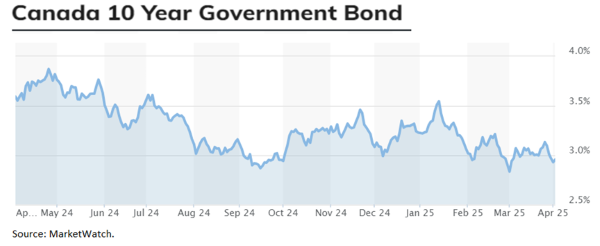
With the trade war looming over the Canadian economy, it’s likely that the Bank of Canada will continue to ease its monetary policy in the near future. As a result, the 2-year yield continues to decline and has reached its lowest level in three years. The 10-year yield edged up slightly (+0.07%) during the month, resulting in a performance of -0.28% for the Canadian bond index.
OUTLOOK:
Economy:
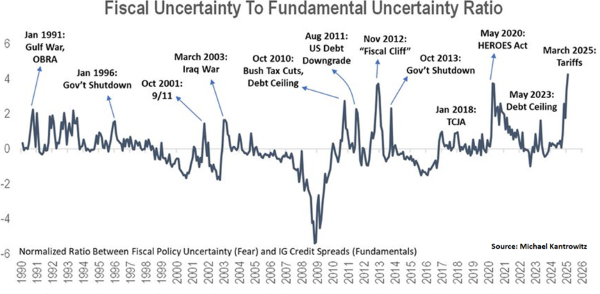
Donald Trump’s negotiating strategy is to unbalance his opponents by injecting a strong dose of uncertainty into the air. This fiscal uncertainty is the highest in 35 years.
Normalized fiscal uncertainty since 1990 (United States):
A review of the literature on tariffs concludes that there are no net benefits for the country that implements them.
In the short term, we expect higher inflation and slower growth. This is called stagflation, and it’s the worst of both worlds. As we speak, the betting markets (Polymarket) are giving a 48% probability of recession in the United States in 2025.
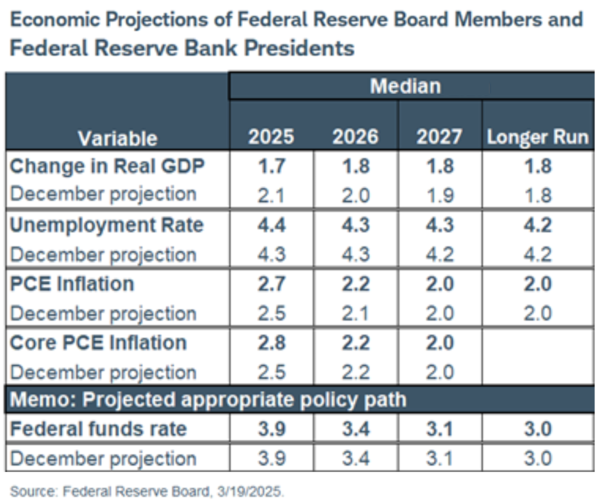
At their last meeting, the Federal Reserve revised their projections accordingly.
• Lower growth
• Higher unemployment rate
• Higher inflation
Federal Reserve Economic Projections (March 19 meeting):
Now that April 2nd is behind us, these projections will likely be revised downward in the next fiscal year.
The weighted average rate of US tariffs is now 29%, the highest level in the last 100 years. In addition to being extremely high, the speed of their implementation is also extraordinary.
Weighted average rate of US tariffs following the April 2nd announcement:

In the United States, everyone is paying the price of the tariff war.
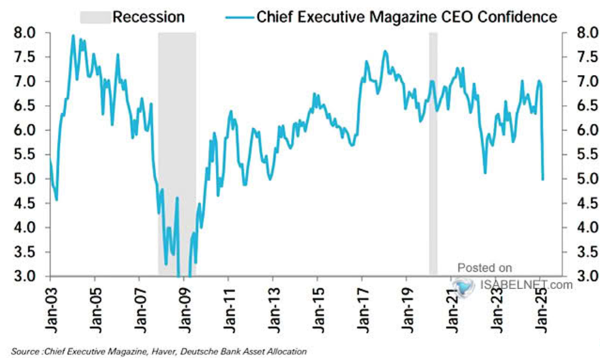
Uncertainty and tariffs have caused CEO confidence to plummet. When their confidence declines, they delay expansion projects, delay hiring, and reduce their share buybacks.
CEO Confidence (United States):
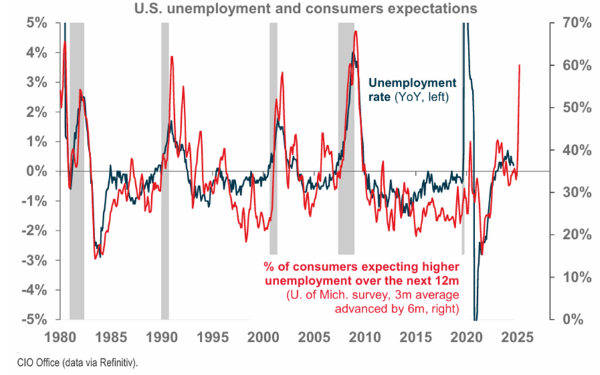
The percentage of consumers anticipating higher unemployment skyrocketed in the latest update of the University of Michigan Consumer Confidence Survey. Typically, their concerns are realized, and unemployment increases significantly within six months, leading to a recession.
Percentage of consumers anticipating higher unemployment and unemployment rate (United States):
In addition to losing purchasing power, the significant decline in stock portfolios is putting downward pressure on household consumption. Even American oligarchs are affected. Indeed, since Trump’s inauguration, their shares have lost nearly 20%.
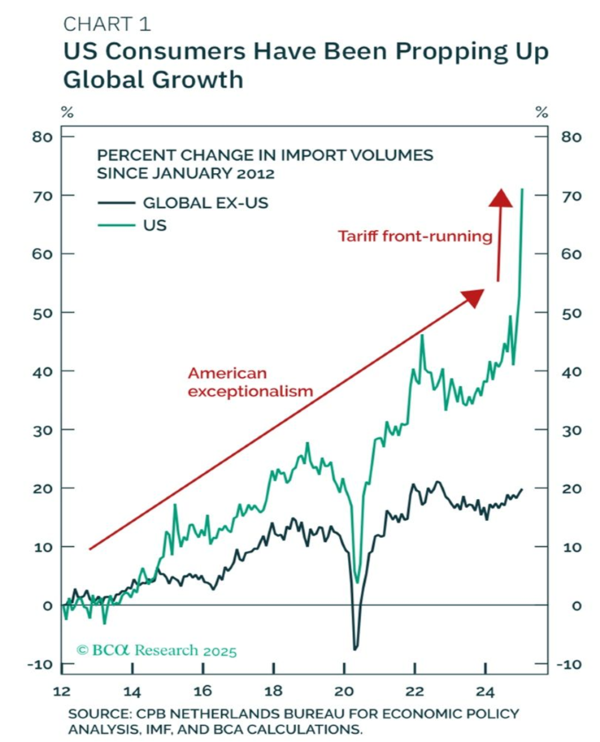
In the short term, it is difficult to predict what the impact will be on economic data. Having announced Liberation Day on April 2nd for several weeks, companies have been importing to build up their inventories before the tariffs take effect. These large imports risk hampering growth figures in the first and second quarters.
US and global imports (Ex-US):
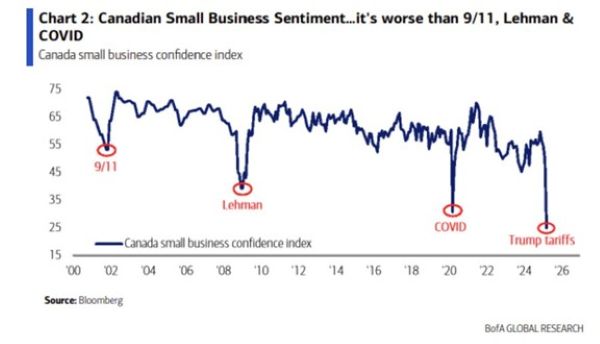
In Canada, the situation is even worse. We are a small exporting country. As the following graph shows, small business confidence is at an all-time low. The current situation is worse than in 2001, 2008, and 2020!
Small Business Confidence: Canada
Fixed Income:
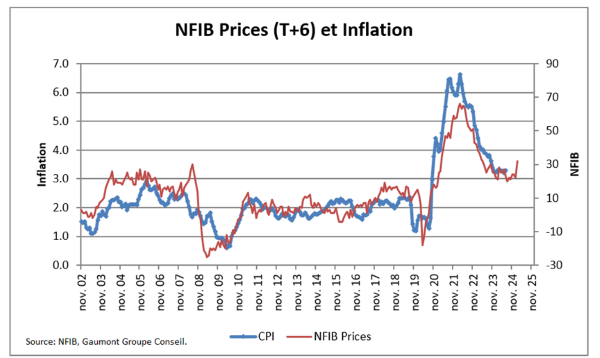
The price indices for manufacturing and small businesses are gradually rising, even though the majority of tariffs were not already in effect. The tariffs will definitively increase prices in 2025. If there is no tariff escalation, there should be no inflationary spiral.
NFIB Price Index (United States):
We continue to monitor wage pressures. High fears of rising unemployment are putting the upper hand on employers. Therefore, pressures are likely to be contained.
Voluntary Exit Rates and Wage Increases (United States):

In the absence of an inflationary spiral, the Fed will face pressure to lower interest rates, given the heightened risk of recession this year. Market participants currently forecast a 0.85% cut in the federal funds rate in 2025.
Implied short-term interest rates (US):

The expected decline in economic growth in Canada is leading to an increase in the corporate credit risk premium. This is attractive for savers. Currently, this diversified, high-quality portfolio yields an annual premium of 1.01% higher than a Government of Canada bond with the same maturity (approximately 7 years).
Risk premium (credit spread) for high-quality Canadian corporate bonds:

Stock Markets:
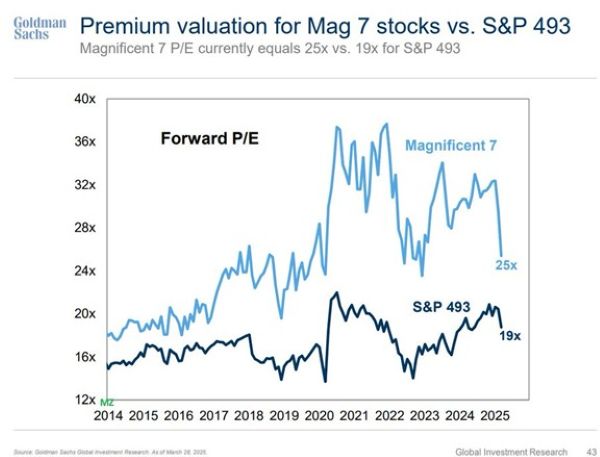
We’ve been talking about it for a while: the US market is expensive, even more so for technology stocks. This excess valuation has almost disappeared. The Mag7 multiple has fallen back to its pre-pandemic level, while the S&P 493 is close to its 10-year average.
Assessment of the Mag7 and the S&P 493 (US):
If we look at the valuation multiples of various stock markets around the world, we see that we are at the lower end of the medians, except in the US. However, it’s important to remember that the US market now offers much higher growth than in recent history. Greater growth potential generates a higher multiple.
Valuation multiples are not, in themselves, a buy signal. They allow us to avoid overpaying for securities and suffering a permanent loss of capital.
Valuation multiples of various stock markets:

Warren Buffet said: « Buy when there’s blood in the streets. » There’s no doubt that’s where we are right now. We’re seeing panic everywhere. Many investors are liquidating their investments, and bargains are emerging.
Mr. Buffet wasn’t just talking empty words. Numerous analyses and indicators show us that it’s working. When investors anticipate rising unemployment, they panic and sell. See for yourself the buying opportunities in the following chart.
Percentage of consumers who anticipate rising unemployment (United States):

Another example is the Panic vs. Euphoria tactical model from the firm SentimenTrader. They have developed, with supporting data and statistics, a model that identifies buying opportunities. These signals have been very profitable in terms of performance, as evidenced by the following charts and tables.
Panic vs. Euphoria Tactical Model (United States):

How will the trade war evolve? Given Donald Trump’s unpredictability, it’s difficult to say.
However, we do know that:
• Tariffs are a bad idea for Americans
• The midterm elections are coming up fast, and he’ll want to avoid any unrest
• Various countries will likely make some concessions, and Trump will be able to declare victory and reduce or remove the tariffs
• The weakness of the US stock market will put pressure on him
In short, this war can’t drag on for a few years.
To value a company’s stock, its profits are discounted in perpetuity. A blip over a few quarters doesn’t affect the company’s long-term value. This is why panics are often good buying times for a long-term investor.
CONCLUSION :
The current stock market panic presents an excellent opportunity to acquire quality securities at attractive fundamental valuations. It is important to maintain well-diversified portfolios, both geographically and with fixed-income securities.
Frédéric Mercier CFA, SIPC
Director – Financial markets