
FINANCIAL MARKET REVIEW:
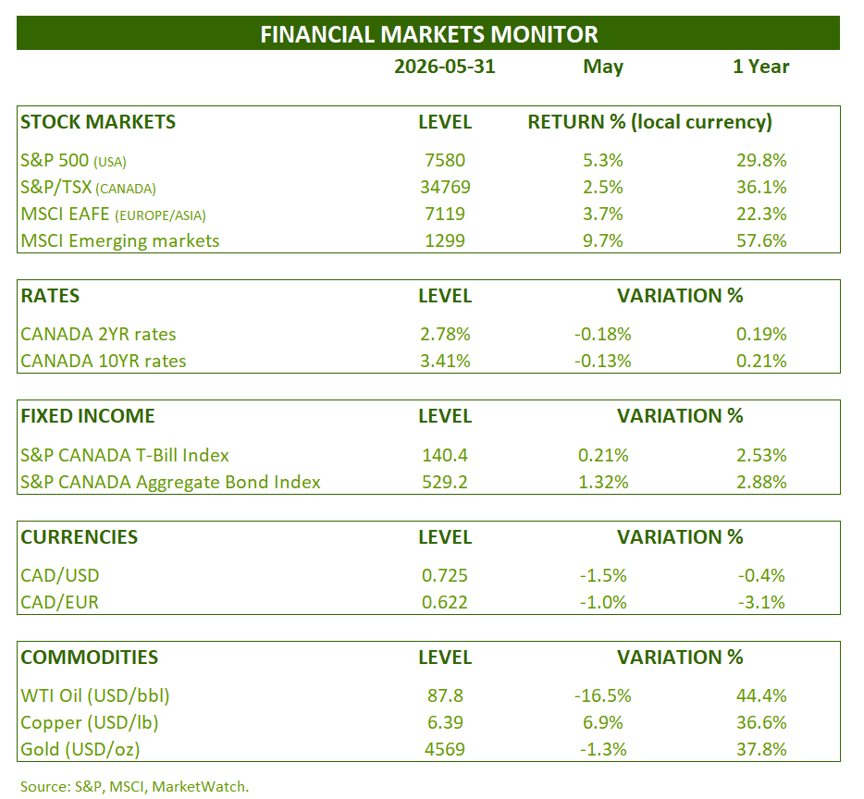
Another strong month for the financial markets. While negotiations to end the war in the Middle East progressed and oil prices fell, global stock markets continued their strong momentum in May.
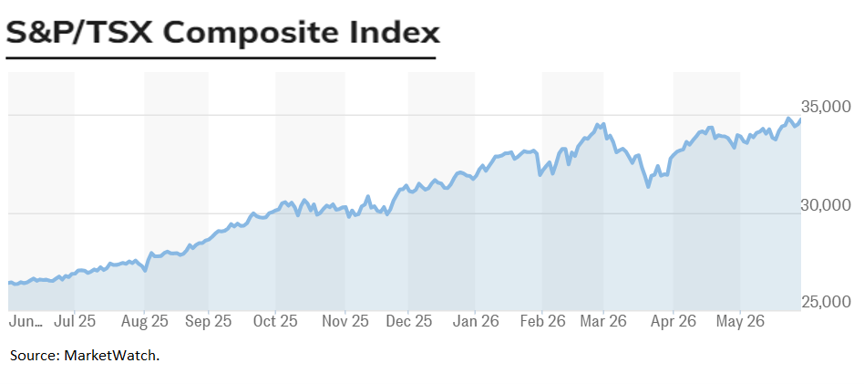
The US market rose 5.3% during the month. Technology stocks were the biggest contributors, gaining 16%. Semiconductor companies, the new darlings of the stock market, rose by more than 25% and have practically doubled in value in just two months. The S&P/TSX Composite Index generated a return of 2.5%, with strong performance from basic materials. Emerging markets, with semiconductors accounting for more than 25% of their portfolios, saw an impressive 9.7% gain.
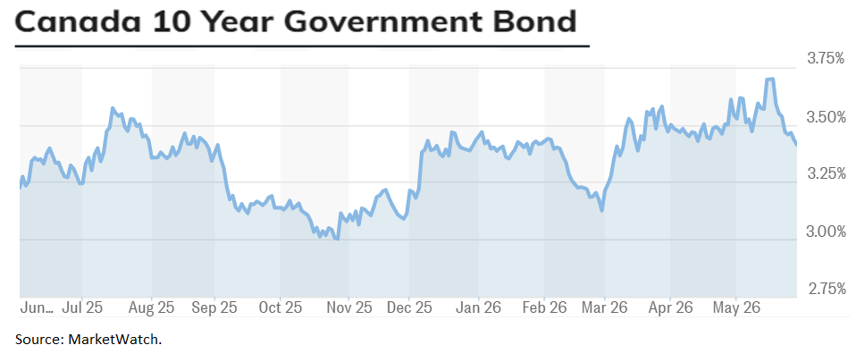
The sharp drop in oil prices helped to calm inflation concerns. Interest rates remained highly volatile throughout the month, but ended with a significant decline. Indeed, the 2-year and 10-year maturities both finished the month lower, with respective decreases of -0.18% and -0.13%.
As a result, the Canadian bond index performed strongly, rising by 1.32% in May.
OUTLOOK:
Economy:
The conflict in Iran is entering its fourth month, and while negotiations appear to be progressing, the impact on the global economy is difficult to assess precisely. It’s worth remembering that the Strait of Hormuz isn’t just used by the energy sector. Essential components for the agricultural, semiconductor, and even healthcare sectors transit through this strait.
We continue to monitor PMI indices worldwide. The global manufacturing PMI remained at 52.6 in May, which is good news.
S&P Global Manufacturing PMI:

The AI-powered chatbot ChatGPT was launched on November 30, 2022. Several other models have also been launched, such as Claude from Anthropic.
Are we beginning to see their impact on the productivity of various sectors and the economy? Looking at the inflation-adjusted revenue per employee of large companies (S&P 500), we see a significant increase since 2024. We are at a peak not seen in over 20 years. There are certainly other factors at play, but the impact of artificial intelligence is nonetheless significant.
Real revenue per employee of large companies (S&P 500) (United States):

In the previous letter, we discussed the concept of a « K-shaped » economy, where one part of the population becomes wealthier while another struggles.
The following graph presents the productivity and real labor costs for the 1990-2000 and 2016-2026 cycles. In both cases, we observe a rapid increase in productivity. However, the 1990s cycle is accompanied by a parallel rise in labor costs. Conversely, since 2021, despite rising productivity, labor costs have stagnated. It is difficult to precisely quantify the impact of artificial intelligence, but it is likely significant.
Productivity and Real Labor Costs (United States):

What happens in the economy when productivity increases much faster than wages? Profit margins increase. This is exactly what is happening right now, and not just in large corporations. In fact, if we look at corporate profits in the U.S. national accounts, we see that they represent 13.8% of U.S. GDP, an 80-year high. American companies are in very good financial health.
Corporate Profits as a Percentage of GDP (United States):

Fixed income:
Gradually, supply chains are beginning to feel the effects of the war in Iran. Oil prices have risen significantly, but the increase has been mitigated by the use of strategic reserves and high inventory levels in general. In this context, it is not surprising to see producer prices rising rapidly, as shown in the following graph. It is difficult to assess the medium-term impacts on inflation. This is not without reason why interest rate volatility is high.
Producer Price Index (United States):

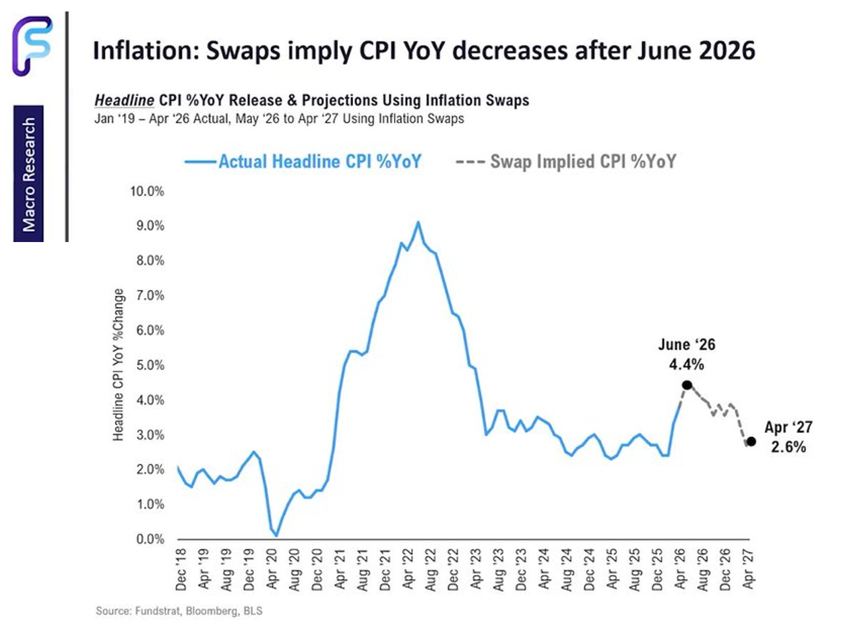
Since short-term inflation models are difficult to accurately reflect, the best indicator is found in inflation swap markets.
Currently, medium-term expectations are subdued, as illustrated by the following charts. The US CPI is projected to peak in June 2026 at an annual rate of 4.4%, before declining to 2.6% in April 2027.
Implied inflation in the US swap market:
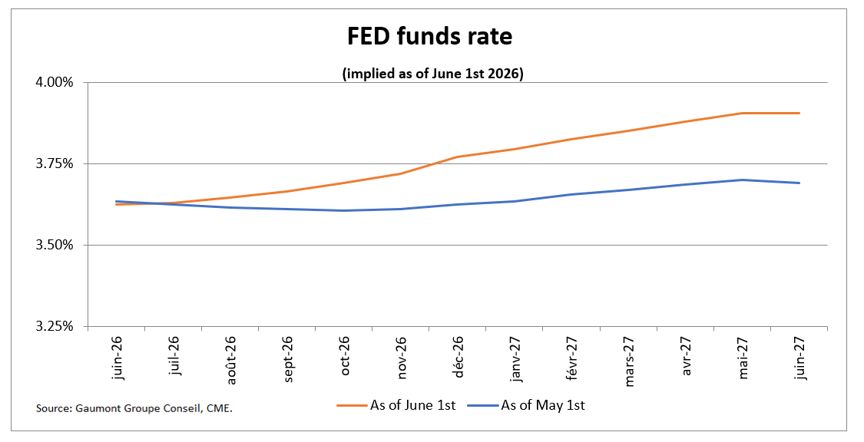
Expectations for the Fed’s key interest rate rose again in May. The Fed is expected to raise its key interest rate by a quarter of a point by June 2027.
In Canada, where rates are 1.4% lower, rate expectations now point to a 0.25% increase by the end of 2026.
Short-term implied interest rates (United States):
Globally, long-term (30-year) interest rates are at their highest levels since the 2008 crisis. They cannot rise significantly further without impacting the markets. This warrants close monitoring.
Long-term interest rates (United States):

Stock Markets:
S&P 500 profits were very strong across the vast majority of sectors. Both sales and profits were robust. This phenomenon wasn’t unique to the United States; it was observed worldwide.
Sales and Profit Growth in S&P 500 Sectors (United States):

Analyzing the returns achieved in 2026 reveals that they stem primarily from anticipated corporate profit growth. Profit growth (both actual and anticipated) is so strong that multiples are falling. This is the opposite of an exuberant market where the same level of earnings is consistently higher.
Breakdown of 2026 stock market returns – various regions
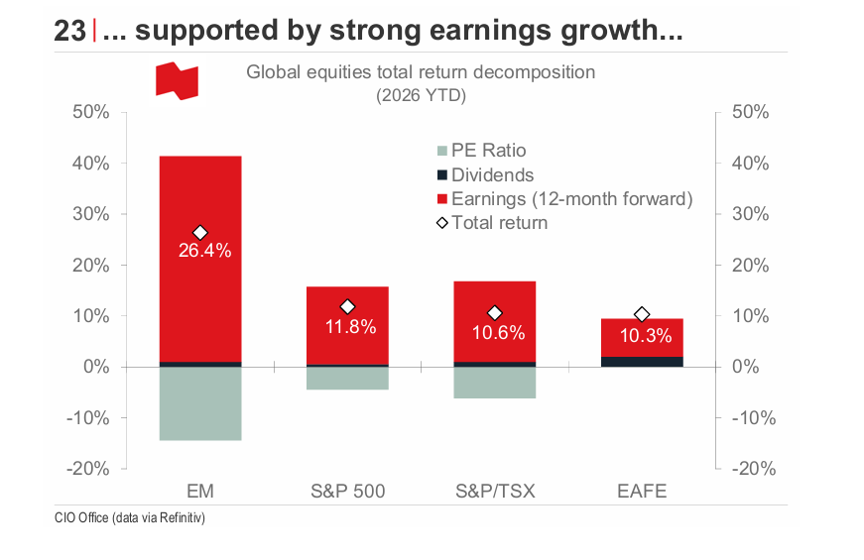
At first glance, these returns appear to be supported by a more solid foundation than mere speculation. Unfortunately, as profits grow rapidly, it’s sometimes easy to get carried away by optimism. In short, the expected profits will not necessarily be realized. The following chart shows that when long-term profit expectations are very high, returns are mediocre the following year.
Long-term profit expectations for S&P 500 companies:

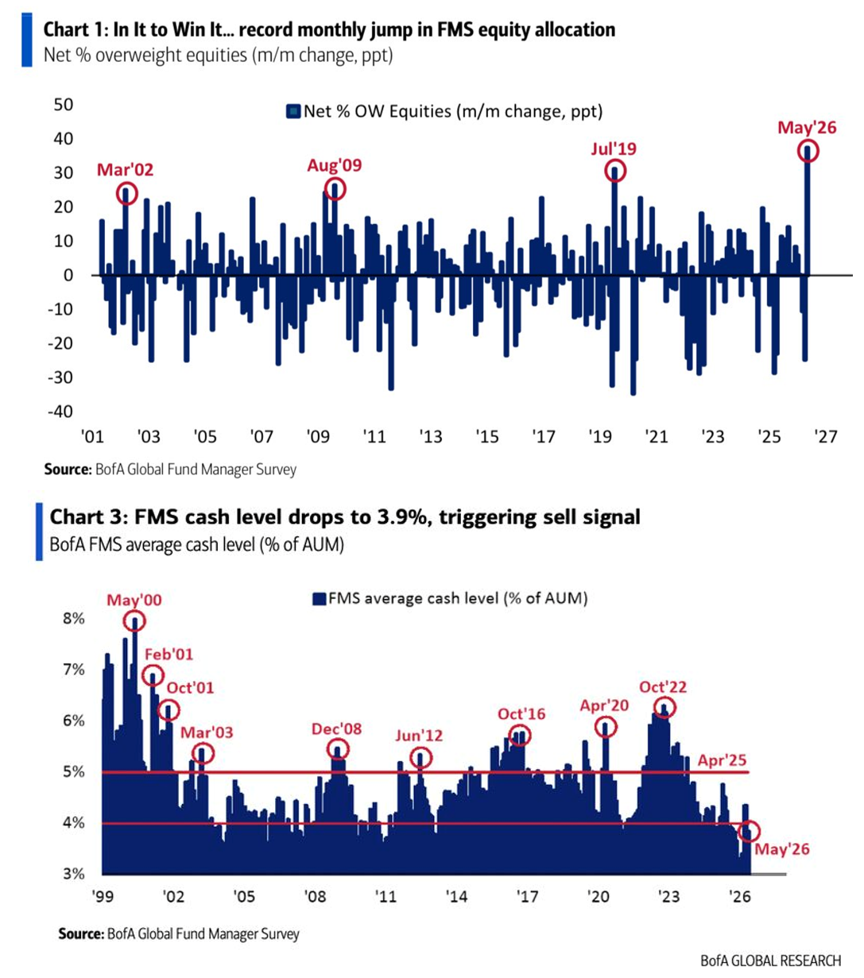
In the short term, signs of euphoria are multiplying. As the following chart illustrates, the increase in equity weighting reached a peak in May. Meanwhile, cash weighting has reached a level typically observed in overheated markets. Furthermore, the share issuance by OpenAI, Anthropic, and SpaceX is likely to fuel this euphoria.
Investor Market Sentiment (United States):
CONCLUSION:
While geopolitical risk, oil prices, and interest rates are high, it’s surprising to see so much optimism in the stock markets. The MSCI World Index generated nearly 12% in 2026. Opportunities are becoming scarcer in the stock market. A rebalancing (involving profit-taking) towards bonds would be appropriate.
Frédéric Mercier CFA, SIPC
Director – Financial Markets