

FINANCIAL MARKET REVIEW:
Despite sharp interest rate hikes, the S&P 500 index limited the damage with a performance of -0.3% in September. However, beneath the surface, 9 of the 11 sectors posted negative returns. Only Technology (+4.5%) and Communication Services (+4.3%) ended the month in positive territory. Growth and momentum factors came back into favor.

In Canada, the S&P/TSX index fell by 2.6% last month. As in the United States, the technology sector was the only positive contributor, posting a gain of 3.5%.
European/Asian and emerging markets also ended September in negative territory, with returns of -1.7% and -0.4%, respectively.
On September 16, the Federal Reserve raised its benchmark interest rate by 0.25%, bringing it to 3.88%. This marked the first hike since July 2023. The market currently assigns an 80% probability to an additional rate hike in 2026.
Interest rates on 2-year and 10-year maturities ended the month sharply higher. The 2-year rate rose by 0.36%, while the 10-year rate increased by 0.26%.

Consequently, the performance of the Canadian bond index fell sharply, dropping 1.12% in September.
Rate hikes in Canada were modest compared to those of our southern neighbor. This is why the Canadian dollar took such a beating, falling 2.7%.
OUTLOOK:
Economy:
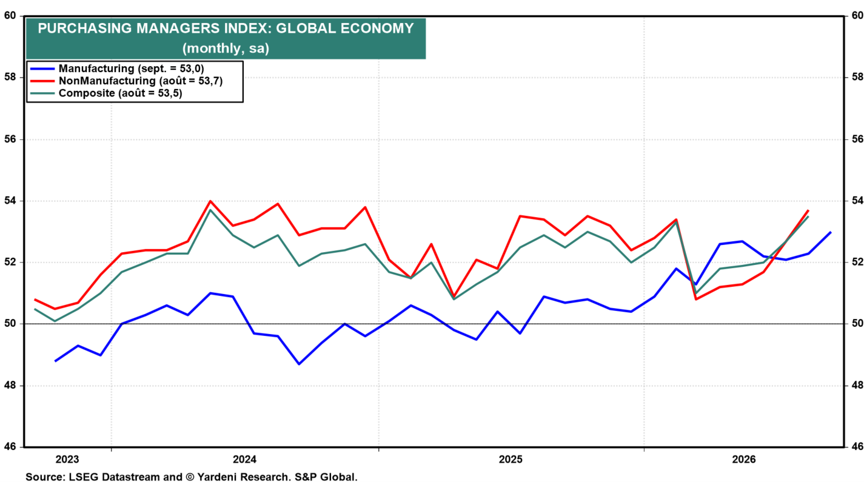
Leading indicators of global industrial production continue to advance rapidly. Indeed, the Global PMI reached a 55-month high in October. Capital investment linked to artificial intelligence is a contributing factor to this resilience. We will return to this point.
Global PMI Indices – Manufacturing and Non-manufacturing:
The new orders and employment sub-components also continue to rise.
Global Manufacturing PMI – new orders and employment:

Job growth continues in the United States, although full-time employment is stagnating. This environment allows the Fed to temper its enthusiasm for rate hikes. Furthermore, wage growth remains under control, hovering between 2.5% and 3%.
Jobs: full-time and total (United States):

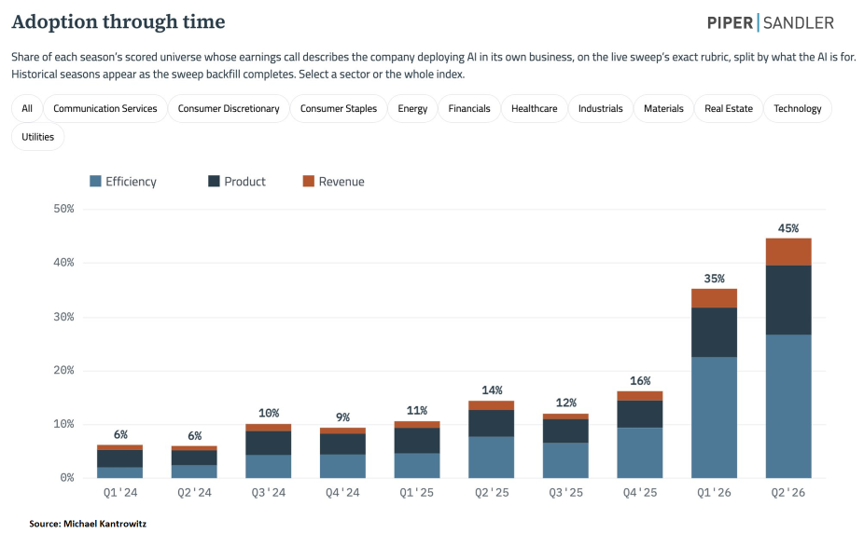
The chart on the following page shows the level of artificial intelligence adoption among companies in the U.S. S&P 1500 index. While adoption stood at 15% in the fourth quarter of 2025, it has now reached 45% just six months later. This adoption is driven primarily by efficiency gains, but also extends to product development and sales. These aggregated figures make it easy to understand the sheer scale of investment involved and how the demand for microprocessors is causing shortages.
AI adoption in the S&P 1500 (United States):
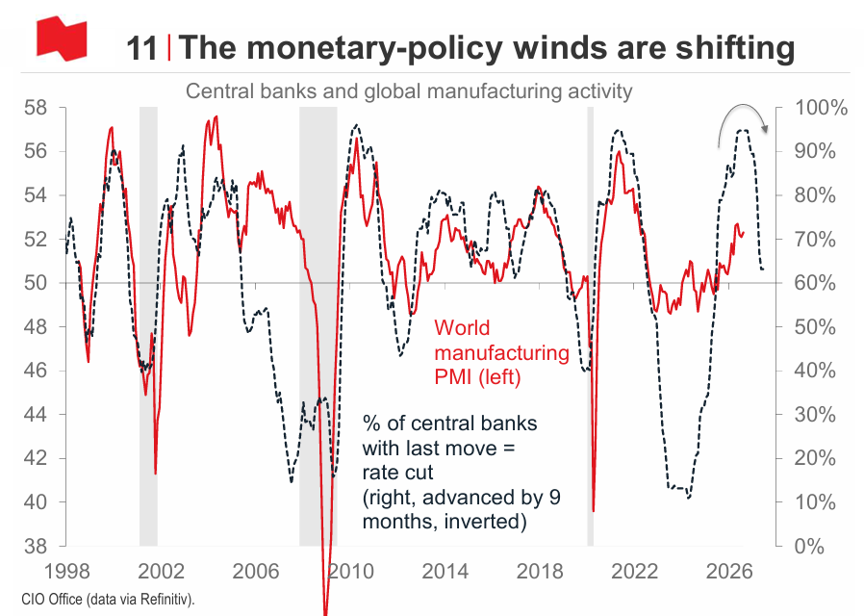
Despite the economy’s current resilience, it is worth remembering that it operates in cycles and that interest rate changes take approximately 9 to 12 months to affect the economy. Consequently, the recent rate hikes by central banks will impact the global economy in the second half of 2027.
Fixed income:
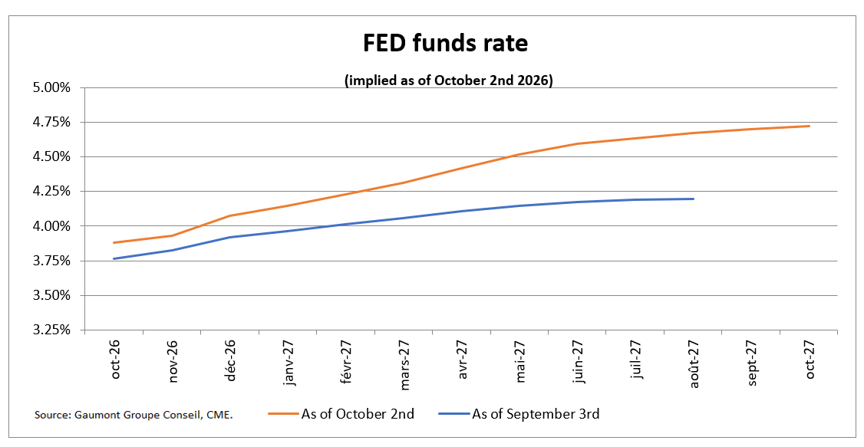
Despite the hike in the U.S. benchmark interest rate in mid-September, investors still anticipate further rate increases. Expectations are that the Fed will raise rates by 0.25% by December and by another 0.50% in the first half of 2027.
The Canadian rate is expected to follow a trajectory more or less mirroring that of its southern neighbor.
Implied short-term interest rates (United States):
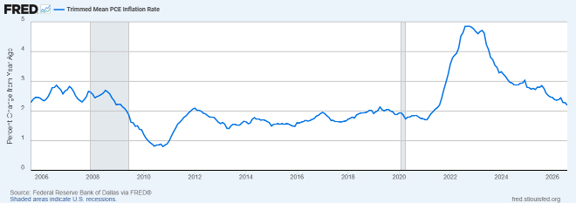
Looking at the PCE inflation index—the measure of inflation preferred by the US Federal Reserve—it appears that inflation is gradually moving in the right direction.
Personal Consumption Expenditures (PCE) price index (trimmed mean) (United States):
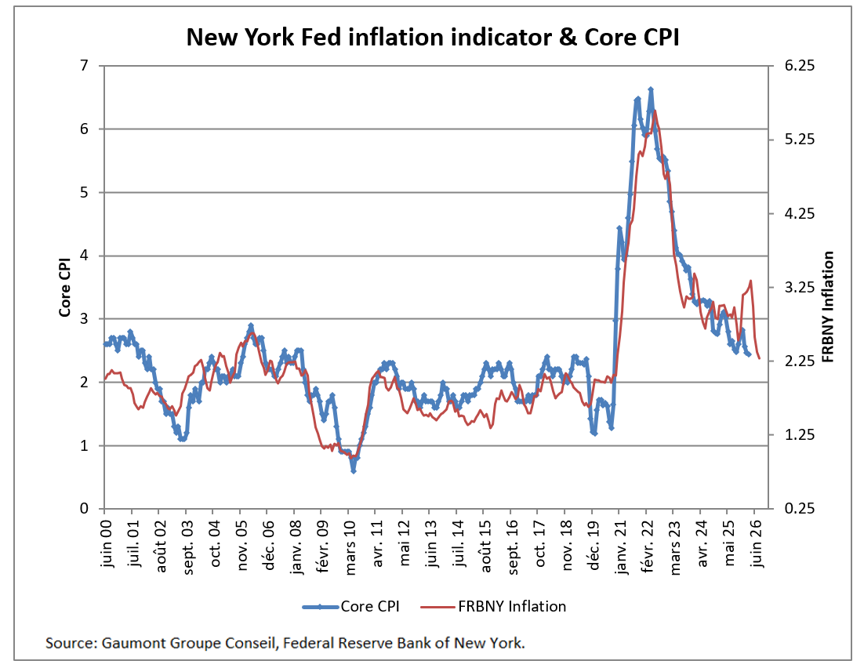
The Federal Reserve Bank of New York’s leading inflation indicator points in the same direction.
With easing inflationary pressures and long-term rates already high, the Fed will likely be able to afford to be less aggressive with its rate hikes.
Leading inflation indicator (NY Fed) and core inflation (United States):
As previously mentioned, 10-year interest rates are hovering near 15- to 20-year highs.
10-year rates (Global):

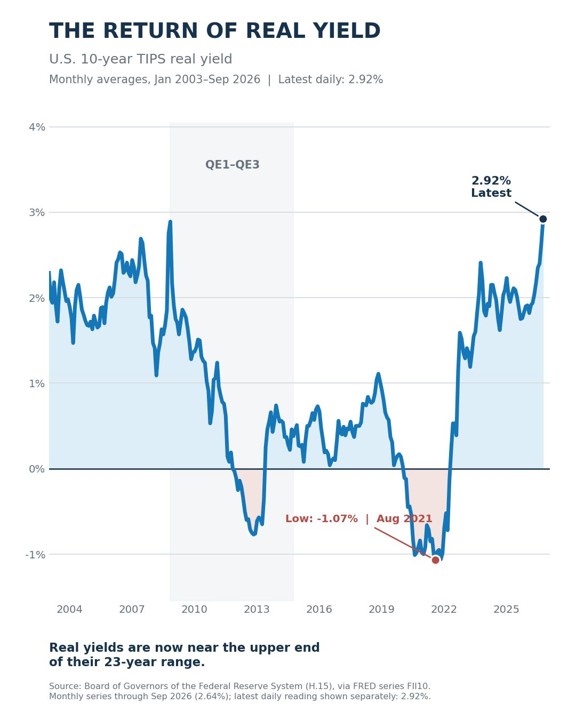
Moreover, these increases are not driven by inflation fears, but rather by a rise in real rates. One has to go back to June 2007 to see rates this high. From an economic standpoint, these rates are highly restrictive. However, from an investor’s perspective, they are a windfall. An investor can lock in a return of 2.92% plus realized inflation.
10-Year Real Rates (United States):
Stock Markets:
Earnings for the index have grown at a breakneck pace in recent quarters, including a 32.4% year-over-year increase in the second quarter. Projected earnings growth for the quarter was 21.7%, representing a positive surprise of more than 10%!!!
Projected earnings growth for the S&P 500 index:

Profits are also projected to grow rapidly in the coming quarters. The fundamentals are solid—there is no doubt about that. However, it is important to remain critical and avoid complacency or euphoria. The bar keeps rising for companies, making it increasingly difficult to beat analyst expectations.
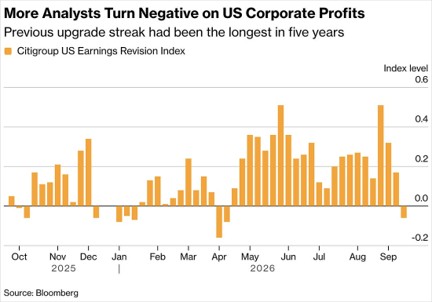
Analysts lowered their earnings forecasts last month. One month does not make a trend, yet this remains the key factor to watch.
US equity profit revisions:
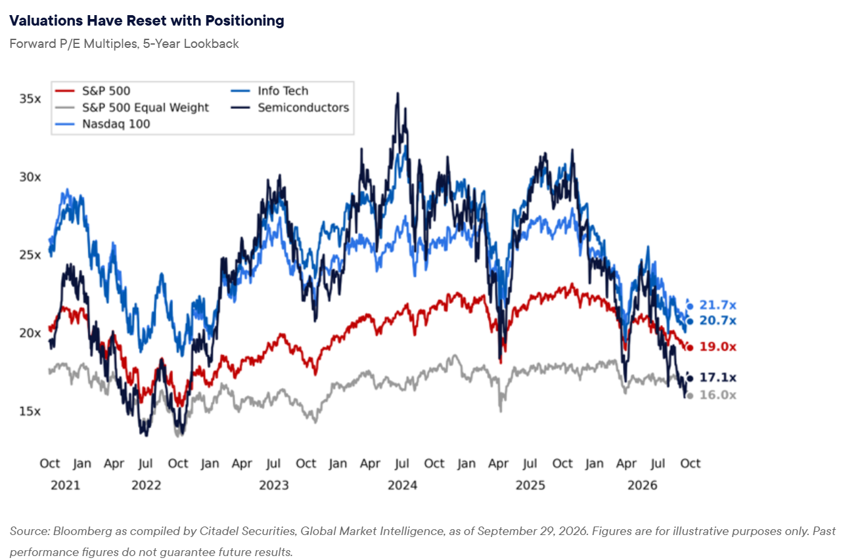
The sharp rise in interest rates has directly impacted equities by lowering price-to-earnings ratios.
The various indices shown in the following chart are hovering at the low end of their valuation multiples. While these levels are attractive, it is important to remember that they imply very high—and likely unsustainable—long-term profit growth.
Evolution of the price-to-earnings multiple – US market:
The six-month stock market period beginning on November 1st is generally very favorable, unlike the other six months of the year. This effect is usually amplified during midterm election years, as uncertainty dissipates for the two years following the vote. While this is not a reason in itself to buy stocks, it serves as a reminder of a period characterized by favorable tailwinds.
Performance of the S&P 500 during U.S. midterm elections.

CONCLUSION:
Rising interest rates have directly impacted equity valuations. Bonds are highly attractive, as are interest-rate-sensitive stocks. Equities worldwide can also be considered attractive. Let us keep portfolios well-balanced with high-quality securities.
Frédéric Mercier CFA, SIPC
Director – Financial Markets